
OEM Perfume Manufacturing in China: The Process, Step by Step
OEM perfume manufacturing in China follows a seven-step process that is identical in shape to any contract fragrance project, with one difference: for a kids-safe format, each step ends with a document rather than a nod. The formula is reviewed against restrictions, the closure is specified as a tested article, and stability starts while the sample is still under discussion. If you know which document each step must produce, the whole project becomes auditable from the first meeting.
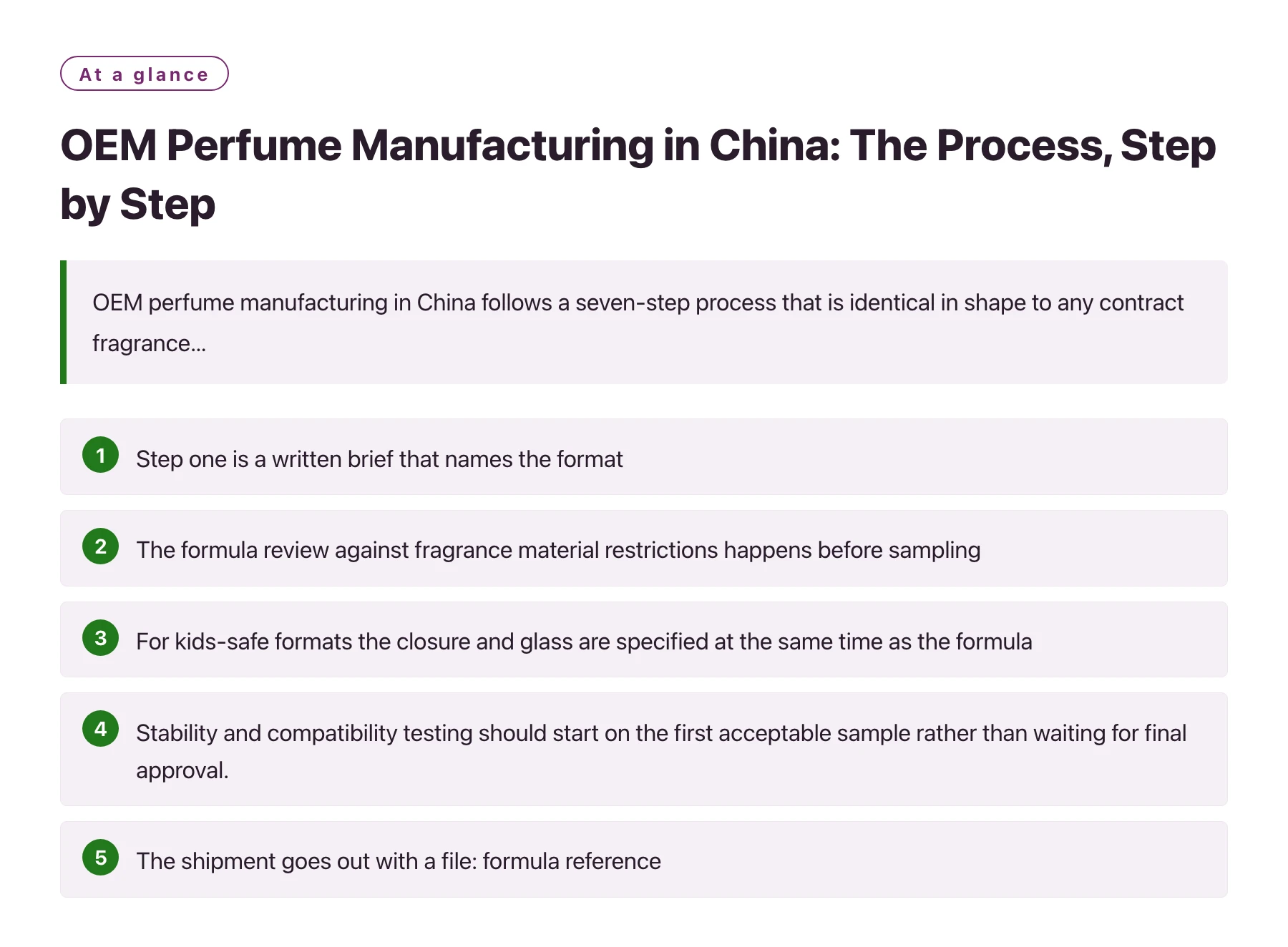
Key takeaways
- Step one is a written brief that names the format, the target markets and the safety specifications — without it every later step is guesswork.
- The formula review against fragrance material restrictions happens before sampling, not after the scent is approved [1].
- For kids-safe formats the closure and glass are specified at the same time as the formula, because they define what the tests must prove.
- Stability and compatibility testing should start on the first acceptable sample rather than waiting for final approval.
- The shipment goes out with a file: formula reference, test reports, label check and batch records — one document set per market [2].
If you have never commissioned a perfume from a Chinese factory, the process can look opaque from the outside: a brief goes in, samples come out, and somewhere in between there are moulds and deposits. In practice the work is fairly standardised, and for a kids-safe line it is also unusually auditable, because the extra requirements force every stage to produce paperwork.
The walkthrough below maps the process from the supplier's side so you know what should be happening at each point — and what should exist in writing before you pay for the next stage.
The seven steps, and the document each one produces
- Write the briefFormat, target markets, fragrance family, price direction and the safety specifications — one page, sent to every shortlisted factory identically.
- Review the formula or directionOEM with your formula, or adapted from the factory's base; the review names the restriction status of each ingredient.
- Specify the pack and closureGlass, decoration and a tested child-resistant closure where required, so the tests have a target to prove.
- Sample roundsTwo or three rounds is normal; each round produces a physical sample, a formula reference and written notes.
- Start stability and compatibilityBooked on the first acceptable sample so the report matures while the design is finalised, not after.
- Pilot fill and first productionThe first run proves the process: fill weights, decoration match and closure performance on real units.
- QC, documents and shipmentPre-shipment inspection, batch records and the per-market document file completed before the goods leave.
The stage map at a glance
| Stage | What the manufacturer does | Document you should hold |
|---|---|---|
| Brief | Confirms feasibility, scope and quote basis | Your written specification, signed off |
| Formula review | Checks ingredients against restriction frameworks | Ingredient or restriction review |
| Pack specification | Quotes closure, glass and decoration options | Itemised pack quotation |
| Sampling | Blends, adjusts and submits physical samples | Formula reference per sample |
| Stability | Tests the product over time under defined conditions | Stability and compatibility reports |
| Pilot production | Fills and decorates a small run to prove the process | Pilot batch record, fill-weight data |
| Shipment | Inspects, packs and prepares the goods | Pre-shipment inspection report, label file, batch records |
Notice that the document column is where a kids-safe project separates from a standard one: the same seven stages exist either way, but only the disciplined file survives an importer's review.
What each step should actually look like
The brief is the cheapest step and the one most often skipped. A kids-safe brief names the format, the markets, the allergens philosophy and the closure requirement up front, which is why factories respond to it with questions instead of a quote — that response is itself useful information.
The formula review is where fragrance safety becomes concrete. Fragrance materials have published safe use levels and restrictions that formulators work to, and the standards published by IFRA are the reference most of the industry cites [1]. Ask the manufacturer to show you the review for your formula: which materials are restricted, why they are present, and what the safe use level means for a product a child may touch.
Stability deserves a special mention because it is the step that cannot be rushed. Once the first acceptable sample exists, the tests should start immediately, because the report takes time to mature. For an OEM kids-safe project — where the closure, glass and formula all have to hold up together — starting stability at final approval is the most common schedule mistake.
The document file is assembled as you go, not at the end. For markets that follow the EU cosmetics framework, that means a product information file covering the specific topics the Commission describes in its cosmetics guidance — safety assessment, composition, manufacturing method and the rest — assembled while the product is still in development [2]. A manufacturer that exports regularly keeps the shape of this file ready, which shortens your own review considerably.
Independent testing sits alongside manufacturing. Third-party laboratories run the stability, compatibility and any regulated closure work, and the reports are what your importer will hold up at the border or at a retailer audit — so specify the programme and the lab in the quote, not after [3].
Where the kids-safe work gets done
Three points in the process carry the kids-safe load: the formula review sets the ingredient profile, the pack specification sets the closure and glass, and the pilot production proves both together on real units. If those three steps each produce a document you can read, the rest of the process is standard.
Choosing the right production model alongside OEM
OEM assumes you bring the formula or a detailed specification. That is the right model when the scent is your asset and you want control of the technical definition. But many founders discover during the brief that their project is actually closer to a private label launch — adapting an existing base rather than commissioning a new formula — and private label fragrance production (private label fragrance production) has a different cost and schedule profile.
It can also be worth asking whether the factory offers development as a service at all, because the boundary between OEM and ODM is where expectations drift. An ODM partner for fragrance brands (an ODM partner for fragrance brands) takes the development brief on itself, which changes who owns the technical risk — a decision that should be made in writing in step one, not discovered later.
And if you are sourcing from China specifically, the practical differentiator between factories is process documentation. An OEM perfume manufacturer in China (OEM perfume manufacturer in China) that can show you a sample's full trail — formula reference, restriction review, stability plan, pilot records — is rare enough to be worth the deposit. That trail is exactly what your kids-safe line will be judged on.
If a stage has no document, the stage has not happened. Walk the seven-step map with the supplier in the first call: where they have answers and files, the project will move; where they have reassurance, that is where you will spend the extra time.
Sources
- IFRA Standards Library (International Fragrance Association) —— The IFRA Standards Library lists the restrictions the fragrance industry applies to individual fragrance ingredients, based on safety assessments; it is the reference point for compliant fragrance formulation.
- European Commission: Cosmetic Products — Specific Topics —— EU pages covering specific cosmetics topics such as product claims, nanomaterials and animal-testing rules.
- SGS: Cosmetics, Personal Care & Household Testing —— Testing, inspection and certification services for cosmetics and personal care, including microbiological, stability and safety testing aligned with cosmetics GMP.
Frequently asked questions
How long does an OEM perfume project take from brief to shipment?
There is no honest single number, because sampling rounds and stability dominate the schedule, and both depend on how quickly the scent and pack are approved. A useful planning assumption is that sampling takes several rounds, stability needs its full duration, and pilot production adds its own weeks — so build the calendar backwards from the launch date.
Can I bring my own formula to an OEM manufacturer in China?
Yes — that is the core OEM model. The manufacturer's job is to repeat your formula reliably: sourcing, blending, filling, testing and packing to the same standard every run. You keep the technical definition, and you also carry the risk if the formula does not behave at production scale.
When should the child-resistant closure be decided?
In the pack specification stage, at the same time as the formula review. The closure determines part of the stability and compatibility picture and the whole of the safety test programme, so deciding it late means re-running tests, not just re-ordering a component.
What is the difference between OEM and ODM for a kids-safe line?
OEM means you define the formula; ODM means the factory develops it from your brief. For a kids-safe line the safety requirements are identical either way — the difference is who owns the technical definition and the development risk, and that should be written down before sampling.
What documents should I insist on before the first bulk order?
The formula reference, the ingredient restriction review, the stability and compatibility reports, the closure test report where applicable, and the label file checked against your target markets. If those exist before production, the first order is a process confirmation rather than a gamble.
Stop guessing what your positioning should sound like.
We audit your public surface, score it on the UPV scale, and hand you a written diagnosis — whether you hire us or not.
Book My Diagnostic →